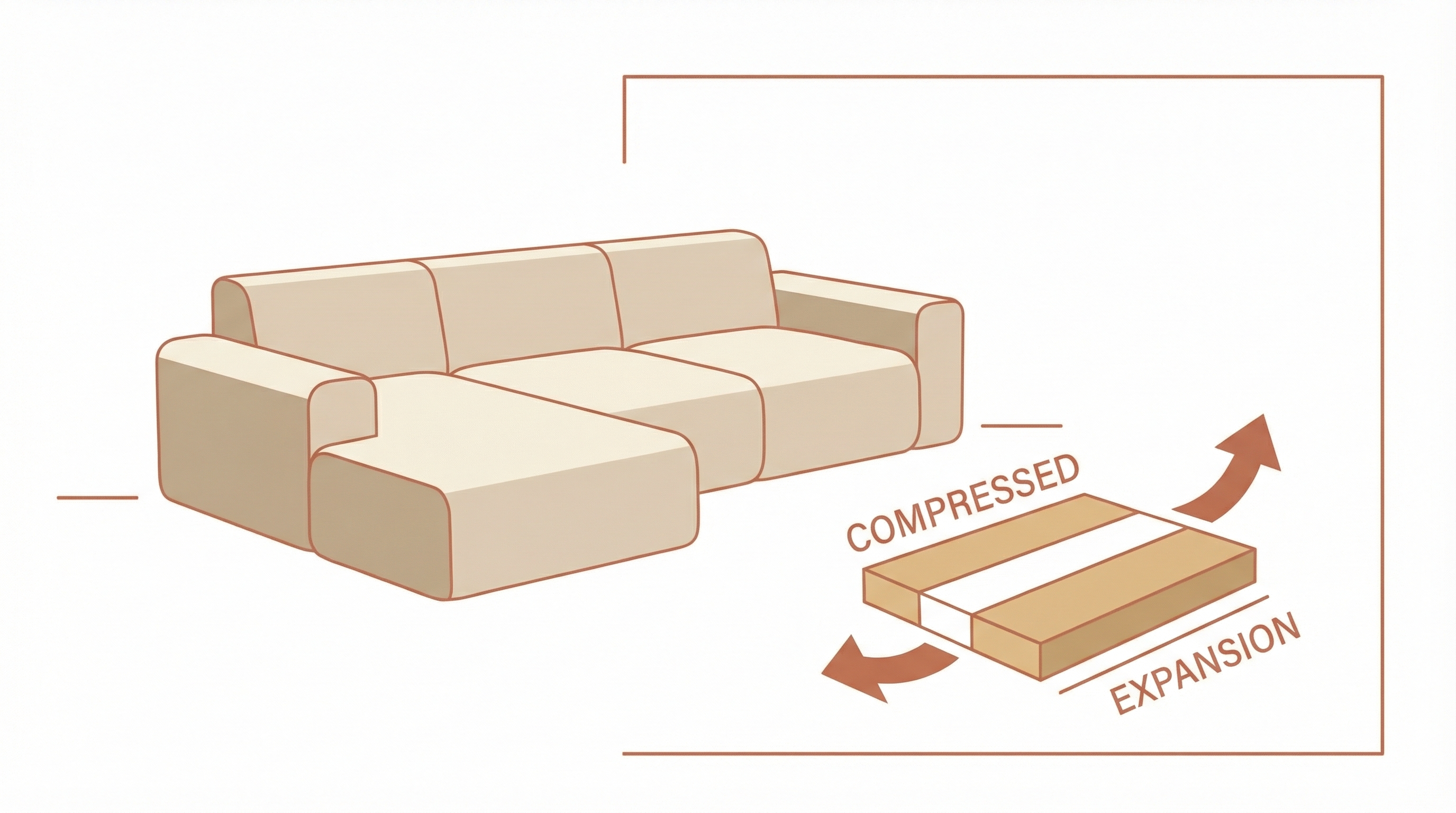
If you’ve spent any time on TikTok in the last year, you’ve probably watched someone slice open a vacuum-sealed bag and watched a couch bloom out of it like a time-lapse of bread rising. That’s a boneless couch — and it’s captured the attention of millions of people who are tired of paying furniture delivery fees and waiting six weeks for a sofa to arrive.
But what exactly is a boneless couch? Is it a gimmick, or a genuine furniture category worth your money? Here’s the complete, honest answer.
The Definition: What “Boneless” Actually Means
A boneless couch is a frameless sofa constructed entirely from foam. There’s no wooden frame, no metal springs, no rigid internal structure — just high-density foam cut and assembled into a sofa shape. The “boneless” name is a direct reference to that absence of any skeleton.
Think of it as a mattress-in-a-box, but for sitting. The same vacuum-compression technology that allowed mattresses to be shipped in a box starting around 2015 has now been applied to sofas. The result is a piece of furniture that can ship in a compact, manageable box — sometimes as small as a large suitcase — rather than requiring a freight delivery and a two-person installation team.
How the Shipping and Expansion Process Works
The process is straightforward, and it’s a big part of why these couches have gone viral.
The manufacturer vacuum-compresses the foam using industrial machinery, removing nearly all the air. The compressed foam is then rolled or folded, sealed in a plastic bag, and boxed. The entire couch — even large sectional configurations — can ship via standard carrier at a fraction of the cost of traditional furniture delivery.
Once you receive your box, the setup is simple:
- Carry the box inside (often doable solo, since even large models weigh 50–80 lbs compressed)
- Unbox and cut the plastic seal — use scissors carefully, the foam expands quickly
- Let it expand — this takes 24 to 72 hours for full expansion and off-gassing
That last point is important. Don’t sit on it immediately. The foam needs time to fully decompress and reach its intended dimensions. Some budget models take closer to 72 hours and never quite reach their advertised size, which is a red flag for foam quality. Quality models are typically at full size within 24 hours.
After expansion, the foam will have a faint chemical smell — this is from the polyurethane manufacturing process. It dissipates within a few days. Airing out the room speeds this up.
The Structure: How Foam Can Function as a Sofa
The obvious question is: how does a blob of foam function as a proper sofa with defined seats, backs, and armrests? The answer is density, shaping, and cover design.
The foam is cut into distinct sections — seat cushions, a back section, and side bolsters or armrests. These pieces are then assembled and encased in a cover (usually a zippered fabric sleeve). The cover’s structure, combined with the foam’s resistance, is what gives the couch its defined shape and firmness.
The foam density — measured in kg/m³ or lbs/ft³ — is the single most important quality indicator. Budget models use 25D–35D foam. Quality models use 45D–50D and above. We’ll cover this in depth in our durability article, but know this now: foam density is the difference between a couch that lasts 18 months and one that lasts 8 years.
Who the Boneless Couch Is For
This furniture category was practically designed for a specific type of buyer. You’ll get the most value if you:
- Move frequently. Urban renters who relocate every 1–3 years don’t want to deal with moving a traditional sofa. A boneless couch can be re-compressed (partially) and moved much more easily.
- Live in a small space. Studios and small apartments often have doorways and stairwells that make traditional sofa delivery a nightmare. A box that fits in an elevator is a real advantage.
- Need something fast. Traditional sofas from quality retailers often take 6–12 weeks to ship. Boneless couches ship in 2–5 days.
- Want low setup hassle. No assembly tools, no help required, no furniture sliders needed.
- Have young kids or pets. The covers are usually removable and washable. Spills and pet hair are much less of an issue.
- Prioritize casual lounging. For movie nights, reading, and relaxing, the low-profile, sinkable feel of a foam couch is genuinely comfortable.
Who Should Think Twice
Honesty requires acknowledging where these couches fall short:
- People with chronic back pain. Without lumbar support structure, extended sitting can aggravate lower back issues. Boneless couches are designed for lounging, not sustained upright sitting.
- Tall people (6’1”+). The back height on most models is relatively low. Tall people often find inadequate head and neck support.
- People who want furniture that lasts a decade. At budget price points ($250–$400), the foam will compress and flatten within 1–2 years. You get what you pay for.
- Anyone prioritizing aesthetics in a formal living room. Boneless couches have a distinctly casual, contemporary look. They don’t suit traditional or formal decor.
- Households that need high seating. The low-to-the-ground profile can be difficult for elderly people or anyone with mobility challenges. (Platform risers can help, but they’re an added cost and complication.)
What to Look For When Buying
If you decide a boneless couch is right for you, here are the non-negotiable factors to evaluate before purchasing:
1. Foam density — Look for 45D or higher. If a product listing doesn’t mention density, that’s a warning sign. Quality brands lead with this spec.
2. CertiPUR-US certification — This means the foam has been independently tested for harmful chemicals, off-gassing, and VOCs. Reputable brands always include this.
3. Cover washability — A zippered, machine-washable cover dramatically extends the practical lifespan of the couch. Dry-clean-only covers are a dealbreaker for most households.
4. Return policy — Some brands offer 30–90 day return windows. Since you need to live with the couch for a few days to assess it properly, a longer return window is meaningful.
5. Size configurations — Most brands offer multiple sizes. Measure your space before ordering, and account for the full expanded size, not just the box dimensions.
6. Weight capacity — Ranges from 300 to 500+ lbs per seat depending on model. If multiple adults will sit on it regularly, verify this spec.
The boneless couch market has grown enormously in the last two years, driven by TikTok virality and the post-pandemic shift toward direct-to-consumer furniture. Like most fast-growing categories, it contains both genuine value and genuine junk. The difference is almost entirely in the foam.
Know the specs, check the certifications, and you’ll find a category of furniture that genuinely solves problems for a specific set of buyers — without the freight delivery, the waiting, or the two-hour assembly.