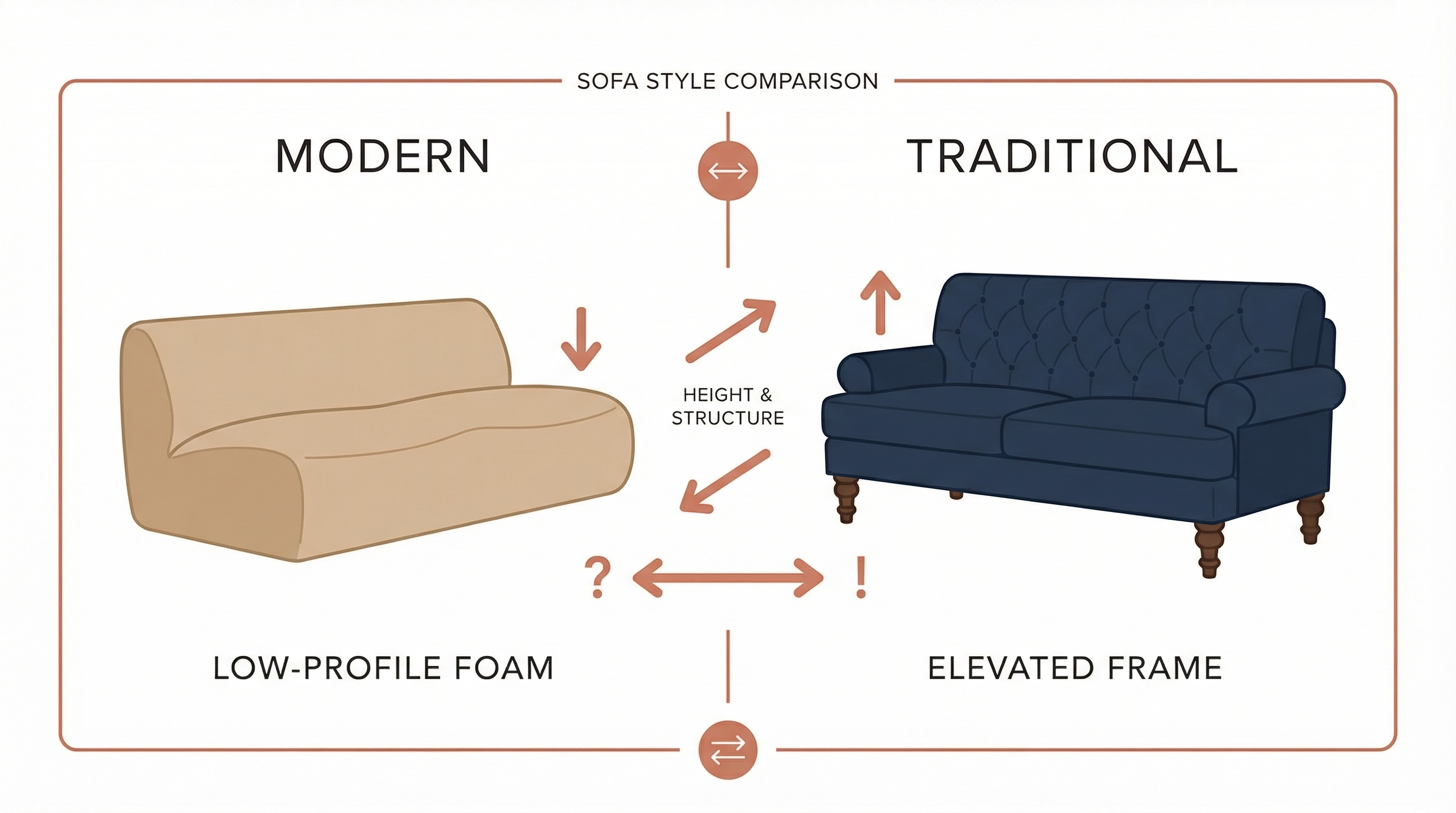
There’s a version of this comparison that’s already been done a hundred times, and it goes like this: “Boneless couches are great for young renters but traditional sofas are better for everyone else.” That framing is lazy, and it misses most of the interesting parts of the actual comparison.
The real answer is more specific, more honest, and more useful. Here’s a category-by-category breakdown that doesn’t pull punches.
Shipping and Delivery
Traditional sofa: Most sofas require freight delivery. The standard process involves scheduling a delivery window, being home for a two-person delivery team, and paying anywhere from $50 to $300 in delivery fees depending on the retailer and your location. For custom or higher-end pieces from retailers like West Elm or Pottery Barn, lead times run 8–16 weeks. You’re also at the mercy of the delivery team’s availability and care.
Boneless couch: Ships via standard ground carrier. Delivery cost is often free (built into the purchase price) or $10–$30. Box arrives like any other Amazon order. Lead time: 2–5 days. No scheduling required, no home delivery window to sit through.
Edge: Boneless couch, significantly. This isn’t even close. The shipping experience alone is a major reason for the category’s rapid growth.
Setup and Assembly
Traditional sofa: “Assembly” typically means two people carrying a heavy piece of furniture through doorways that may not accommodate it. Moving a traditional sofa into a third-floor walkup apartment is a genuine ordeal. Some retailers charge extra for white-glove delivery that includes setup and packaging removal.
Boneless couch: One person can manage the box. Cut the seal, let it expand, done. No tools, no muscle, no maneuvering through tight doorways. The compressed form factor solves the access problem completely.
Edge: Boneless couch. If you’ve ever watched two people try to navigate a sofa around a 90-degree stairwell landing, you understand why this matters.
Comfort: Sitting Style Matters
This is where the comparison gets nuanced, because “comfortable” means different things depending on how you use a sofa.
Traditional sofa: Designed for upright sitting. The combination of a firm frame, spring system, and cushioned seat creates a consistent seating position with lumbar support from the back cushions. This is ideal for social situations, eating on the couch, sustained desk-adjacent work, and formal living spaces where you sit properly.
Boneless couch: Designed for lounging. The foam’s give and the generally lower seat height encourage a more reclined, relaxed position. Watching movies, reading for hours, napping — boneless couches often excel here. Upright sustained sitting, especially for tall people, is less comfortable.
Edge: Depends. If you primarily watch TV and lounge, boneless wins. If you host dinner parties or work from the couch, traditional wins. This is the single most important dimension to assess honestly before buying.
Durability
Traditional sofa: A quality frame (kiln-dried hardwood) with eight-way hand-tied springs and high-resilience cushions should last 10–20 years. Even budget traditional sofas with engineered wood frames and sinuous springs typically last 5–10 years before the frame or springs fail meaningfully.
Boneless couch: As detailed in our foam density article, lifespan ranges from 6 months (budget foam at 25D) to 8+ years (premium foam at 45D+). The best boneless couches approach traditional sofa longevity. Most don’t.
Edge: Traditional sofa at the same price point. However, a $700 boneless couch with 45D+ foam is meaningfully more durable than a $700 traditional sofa, which at that price point likely has a particle-board frame and cheap cushions.
Price
Traditional sofa: Quality starts at around $800–$1,200 for something that will actually last. Sub-$500 traditional sofas exist, but the frame and cushion quality at that price point is marginal. Premium traditional sofas from brands like Interior Define, Article, or West Elm run $1,500–$4,000.
Boneless couch: Quality entry point is around $450–$500 for 45D+ foam. The top end of the boneless market sits at $700–$1,000. You can’t buy a bad boneless couch for more than $1,000 — the category maxes out below where traditional sofas get started at a premium level.
Edge: Boneless couch at the low and mid range. You can buy a genuinely good quality foam couch for $500–$700. Matching that durability and comfort in a traditional sofa requires spending significantly more.
Aesthetics
Traditional sofa: Enormous range of styles, from classic rolled arms to modern low-profile designs to tufted Chesterfields. Any aesthetic is achievable. Traditional sofas fit formal living rooms, mid-century modern interiors, and everything in between.
Boneless couch: The aesthetic range is narrower. Most models have a casual, contemporary look — low profile, rounded shapes, modular configurations. They work well in modern apartments, casual living rooms, and media rooms. They look out of place in formal or traditional interiors.
Edge: Traditional sofa. The aesthetic flexibility of upholstered furniture with a wooden frame is simply broader.
Maintenance and Cleaning
Traditional sofa: Spot cleaning is standard. Most covers are not removable. Professional cleaning is required for deep cleaning. Reupholstering extends lifespan but is expensive ($500–$1,500+).
Boneless couch: The zippered removable cover is a genuine practical advantage. Machine-washing a sofa cover after a red wine spill, a pet accident, or months of general use is something traditional sofa owners can’t do easily. Several brands also sell replacement covers.
Edge: Boneless couch. The washable cover is underrated as a practical benefit.
Resale Value
Traditional sofa: Quality traditional sofas retain meaningful resale value. A well-maintained $2,000 sofa can sell for $400–$700 after 3–4 years. Buyers on Facebook Marketplace and OfferUp actively seek quality traditional furniture.
Boneless couch: Resale value is minimal. A $600 boneless couch typically sells for $50–$150 used, if it sells at all. The foam compression issue makes buyers skeptical, and the category’s association with disposable furniture doesn’t help.
Edge: Traditional sofa. If you’re thinking about total cost of ownership over 10+ years, the resale delta matters.
Sustainability
Both categories have sustainability concerns, but different ones.
Traditional sofa: A well-made traditional sofa that lasts 20 years has a lower environmental footprint per year of use than cheap furniture replaced every few years. However, sourcing matters — engineered wood frames and synthetic fill have their own environmental costs. The wood frame also contributes to end-of-life disposal challenges.
Boneless couch: Polyurethane foam is petroleum-based and not easily recyclable. A budget boneless couch that gets replaced every year or two creates real waste. At higher quality tiers with longer lifespans, the math improves. CertiPUR-US certification addresses chemical safety but doesn’t resolve recyclability.
Edge: Traditional sofa (slightly), assuming comparable quality tiers and long ownership.
The Verdict: Choose Boneless If…
- You move frequently (every 1–3 years)
- You live in an apartment with difficult access
- You primarily use your sofa for lounging and movies
- You have kids or pets who create messes
- You need furniture fast and don’t want to wait weeks
- Your budget is $500–$800 and you want maximum durability per dollar
Choose Traditional If…
- You’re furnishing a long-term home
- You host regularly and need proper upright seating
- You have chronic back issues that require structured lumbar support
- Aesthetics and formal decor are priorities
- You value resale value and long-term ownership
- You’re willing to spend $1,000+ for premium quality
The honest conclusion is that these are complementary categories, not competitors. A boneless couch is a legitimate primary sofa for urban renters and casual loungers. A traditional sofa is better suited for homeowners, formal settings, and those with specific ergonomic needs. Understanding which type of buyer you are makes the decision straightforward.