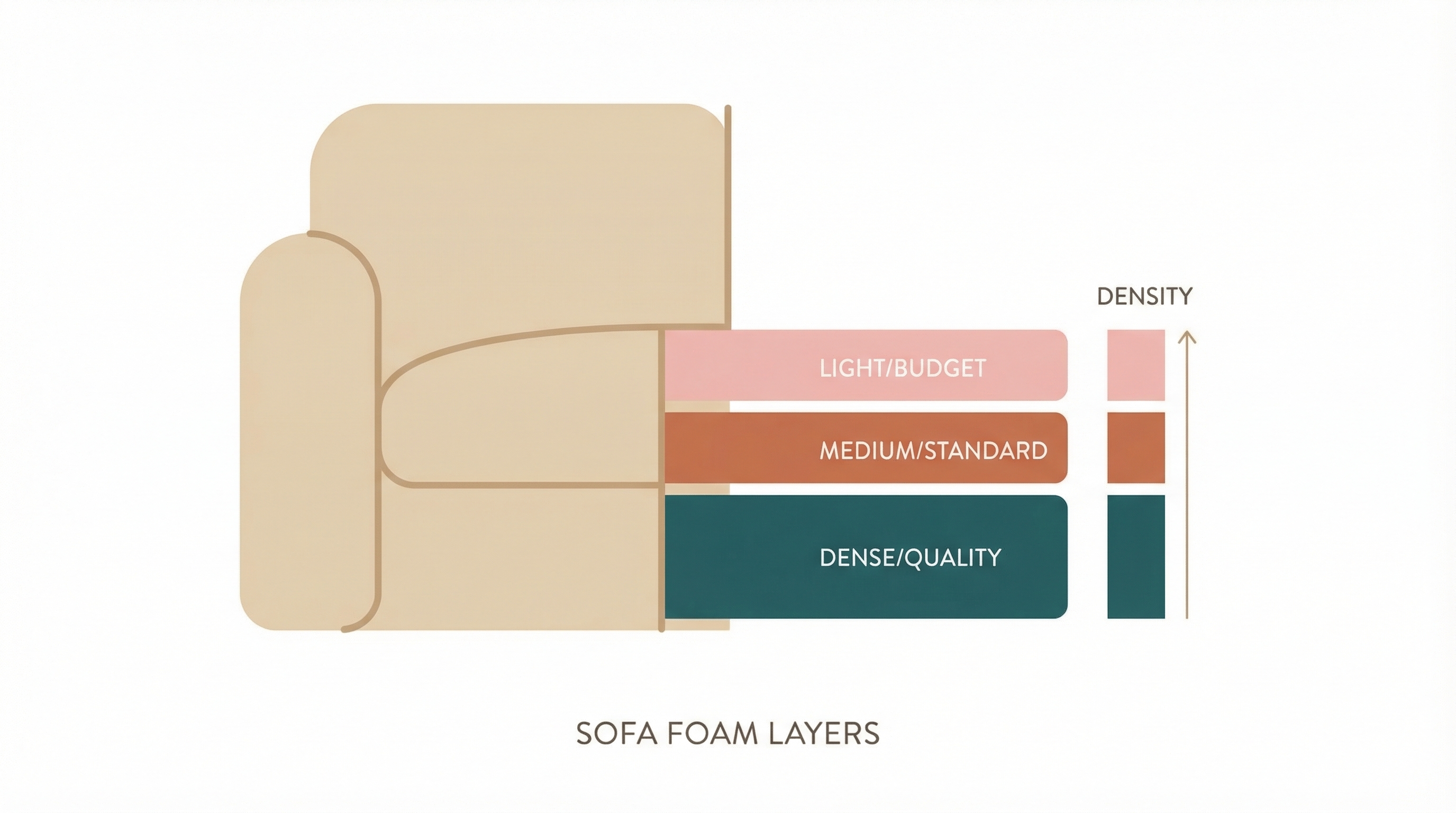
The most common complaint about boneless couches is the same: “It looked great for a few months, then started flattening.” The most common response from people who love their boneless couch is also consistent: “I paid for quality foam and it still feels like new.”
Both groups are right. The difference between these experiences is almost entirely foam density — and understanding it will make or break your buying decision.
What Foam Density Actually Means
Foam density is measured as the weight of one cubic foot (or cubic meter) of foam. Higher density means more foam material per unit of volume. More material means more resistance, more support, slower compression, and longer lifespan.
The measurement you’ll see most often:
- D rating (kg/m³): Used in most product listings. “45D” means 45 kg per cubic meter.
- PCF (lbs/ft³): Used in some North American brands. “3.0 PCF” is roughly equivalent to 48D.
These numbers matter because polyurethane foam — the material in virtually all boneless couches — breaks down through compression cycling. Every time you sit down, the foam compresses. Every time you get up, it tries to re-expand. Lower density foam has less material to push back with, so it reaches its compression limit faster.
The Foam Density Tiers
Budget Tier: 25D–35D
Expected lifespan: 6–18 months of regular use
This is the foam you’ll find in couches priced under $350, and in the wave of generic TikTok Shop and Amazon dropship products that flooded the market in 2024. At this density, the couch feels perfectly fine when it first arrives — sometimes even firmer than expected. The problem develops gradually over months of use.
By month six, you’ll notice the seat areas feel noticeably softer. By month twelve, you may find yourself sinking significantly lower than you did initially. By eighteen months, the foam in high-use areas often develops a visible permanent impression.
This isn’t a defect you can return — it’s the physics of low-density foam under regular load. These models are best treated as temporary furniture or for low-use spaces like a guest room or home office seating area.
Mid-Range Tier: 35D–44D
Expected lifespan: 2–4 years
Better, but still not where you want to be for a primary living room couch. This density range provides acceptable firmness for casual use and resists compression more meaningfully. You’ll notice less dramatic deterioration in the first year, but regular daily use will still cause measurable softening by year two.
Some brands in this range compensate by using multiple foam layers with different densities — firmer foam on the bottom for support, softer foam on top for comfort. This is a reasonable approach, but it doesn’t fundamentally change the long-term trajectory.
Quality Tier: 45D–50D
Expected lifespan: 5–8 years
This is the threshold where a boneless couch becomes a legitimate long-term investment. Foam at 45D and above maintains its shape and support through years of regular use. The compression cycling that destroys budget foam barely registers at this density.
Brands like CoziCave use memory foam in this range with proprietary density treatments. At this tier, you should expect consistent support for 5+ years with normal use, and the foam will outlast the cover in most cases.
Premium Tier: 50D+
Expected lifespan: 8–12 years
Reserved for high-end DTC brands and models using CertiPUR-US certified high-resilience foam. Some models in this tier incorporate hybrid structures — high-density foam combined with pocket spring layers for superior lumbar support and edge firmness.
Ovios falls into this category with their hybrid foam-and-spring construction, which outperforms pure foam models in both support and longevity. At $600–$950, you’re paying roughly what you’d spend on a mid-range traditional sofa — and getting comparable lifespan expectations.
Lifespan Comparison Table
| Foam Density | Price Range | Expected Lifespan | Best For |
|---|---|---|---|
| 25D–35D | $200–$350 | 6–18 months | Temporary, low-use |
| 35D–44D | $350–$499 | 2–4 years | Secondary seating |
| 45D–50D | $500–$800 | 5–8 years | Primary sofa |
| 50D+ / Hybrid | $700–$1,000+ | 8–12 years | Long-term investment |
How Does This Compare to Traditional Sofas?
A decent traditional sofa with springs and a hardwood frame, bought at a mid-range furniture retailer for $800–$1,200, typically lasts 7–15 years. The springs provide consistent support over time, and the frame doesn’t compress.
A premium boneless couch at 45D–50D foam approaches that lifespan at a lower price point. The key difference: traditional sofas wear gradually and predictably, while foam sofas can feel perfectly fine until the compression threshold is crossed — and then feel noticeably worse in a short period.
“The honest comparison isn’t foam vs. springs — it’s density vs. density. Good foam outlasts cheap springs. Bad foam doesn’t outlast much of anything.”
What Shortens a Boneless Couch’s Life
Beyond foam density, several factors affect how long your couch stays comfortable:
Body weight and use frequency. A 200 lb person sitting for 4 hours daily compresses foam at roughly 3× the rate of a 130 lb person sitting for 1 hour. High-use households should prioritize 47D+ foam.
Children jumping. Impact loading accelerates foam breakdown significantly more than static load. If young kids will regularly use the couch as a trampoline, add 20–30% wear to your estimate.
Sun exposure. UV light degrades polyurethane foam. Placing the couch in direct sunlight will yellow and weaken it over time. Use curtains or position it away from windows.
Cover condition. A worn or torn cover stops holding the foam sections in their correct orientation, leading to visible shifting and sagging. Maintaining the cover — or replacing it — extends the couch’s functional life.
Care Tips That Actually Extend Lifespan
- Rotate usage patterns. If you always sit in the same spot, rotate which section faces the main seating direction every 3–4 months.
- Wash the cover regularly. A clean cover maintains its structural integrity and keeps the foam sections correctly positioned.
- Let it breathe. If the room gets humid, the foam can take on moisture, which accelerates breakdown. Good airflow helps.
- Use a cover protector. A fitted sofa protector under the main cover adds a layer of protection against spills, which can degrade foam.
- Avoid prolonged static weight. Don’t store heavy items on the couch for extended periods.
The Bottom Line
The question “how long does a boneless couch last?” doesn’t have one answer. It has four answers depending on what you buy.
At 25D–35D foam, you’re buying a temporary piece of furniture. At 45D+, you’re buying something that can serve as your primary sofa for years. The price difference between these tiers is often only $200–$300. On a piece of furniture you’ll use daily, that’s a straightforward investment.
When shopping, always look for the foam density spec. If a brand doesn’t publish it, ask. If they can’t tell you, move on.