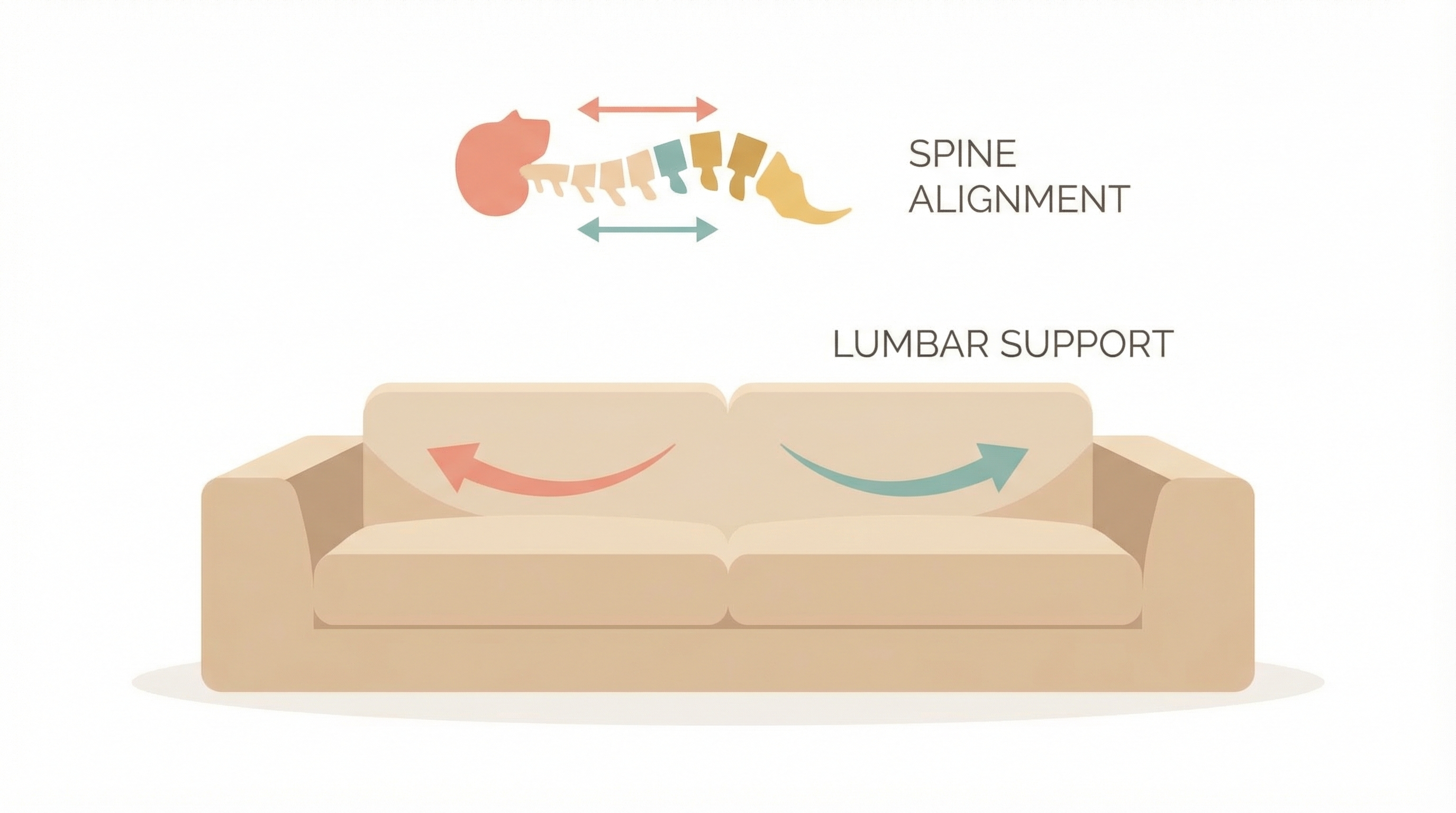
Search “boneless couch back pain” and you’ll find two camps: people swearing their foam couch destroyed their back, and people saying it’s the most comfortable thing they’ve ever sat on. Both groups are probably telling the truth. The key is understanding why.
The answer to whether a boneless couch is good for your back isn’t a simple yes or no — it depends on three specific factors: how you sit, your existing back health, and the foam density of the couch itself.
What “Boneless” Means for Your Spine
A traditional sofa’s back support comes from its structural components: the rigid frame positions the back cushions at a fixed angle and height, and the cushions provide consistent resistance regardless of how much you’ve used the couch.
A boneless couch’s back support comes entirely from the foam. The foam conforms to your body rather than maintaining a fixed position. For some people, this feels like pressure-relieving comfort. For others — particularly those who sit for long periods in an upright position — it means gradually sinking into a C-shaped spinal curve with no structural correction.
The clinical concern with this posture is lumbar flexion: the lower back rounds forward and the natural lordotic curve (the inward curve at the base of your spine) flattens or reverses. Sustained lumbar flexion under load is associated with increased disc pressure, and for people with existing disc issues or chronic lower back pain, this can cause real problems.
When a Boneless Couch Is Fine for Your Back
The key word in most back complaints is “sustained sitting.” For the majority of use cases, a boneless couch is perfectly adequate:
Lounging and reclining. When you recline on a boneless couch — legs stretched out, back at a 120–150 degree angle — the load on your lumbar spine is substantially lower than when you sit upright. Many physiotherapists note that a semi-reclined position is actually easier on the lower back than rigidly upright sitting. A boneless couch naturally encourages this position.
Movie watching. 2–3 hours of reclined TV watching is not the same spinal loading as 8 hours of desk work. For casual watching, the ergonomic risk is low.
Casual, shorter sessions. If you spend 30–60 minutes reading or scrolling before getting up and moving, a boneless couch isn’t going to cause harm for most people.
Healthy adults without back conditions. If you don’t have a diagnosed spinal issue and you move regularly throughout your day, a boneless couch as your evening relaxation spot is unlikely to cause problems.
When to Be Careful — or Avoid Entirely
Chronic back pain. If you have a diagnosed condition — herniated discs, spinal stenosis, spondylolisthesis, chronic sciatica — the lack of structured lumbar support in a boneless couch is a genuine concern. The foam’s conforming nature means you’ll sink into positions that may aggravate these conditions. This isn’t a reason to never use one, but it’s a reason to use it carefully and not make it your primary seating surface.
Working from the couch. If you’re doing sustained, focused work — laptop on your lap, sitting relatively upright for 2+ hours — a boneless couch is not a good ergonomic choice. You need back support that maintains position, not foam that conforms and lets you gradually slump. For work sessions, use a chair with proper lumbar support.
Tall people. Boneless couches typically have back height of 25–32 inches. For people 6’1” and above, this often means the couch back doesn’t reach the thoracic region, leaving the upper back and neck unsupported. This creates compensatory tension in the neck and shoulders over extended sitting.
Post-surgical recovery. Anyone recovering from spinal surgery or acute injury should consult their healthcare provider before using any new seating. The unpredictable conforming nature of foam isn’t ideal when you need consistent positional support.
How Foam Density Affects Back Support
This matters more than most buyers realize. Low-density foam (25D–35D) compresses significantly under body weight. You sink deeper than the couch designers intended, which changes your spinal angle and puts more load on the lower back. People reporting back pain after 6 months of use are often experiencing the foam compression problem, not an inherent flaw in the category.
Higher-density foam (45D+) maintains its shape better under load. You sit where the couch was designed to position you — at the correct depth and angle relative to the back support. The “boneless couches hurt my back” complaint is disproportionately from buyers of budget 25D–35D models.
“If your couch has compressed 30% from its original state, you’re not sitting on the couch as designed — you’re sitting on a failed couch. That’s a foam problem, not a boneless problem.”
Practical Workarounds That Help
If you love the convenience of a boneless couch but want better back support, these modifications make a real difference:
Lumbar pillow. A firm lumbar support pillow placed at the small of your back fills the support gap that foam can’t provide. This is the single most effective and cheap modification. Look for cylindrical or D-shaped lumbar cushions in the $25–$50 range.
Platform base or risers. Most boneless couches sit low (13–17 inches seat height). Adding a platform or furniture risers raises the seat height, which naturally improves the seating geometry and reduces the hip-dropping that causes lumbar flexion.
Armrest use. When the armrests are at the right height, resting your arms on them distributes some of your upper body weight and reduces the slumping tendency. Position yourself so your elbows rest naturally.
Movement breaks. The real enemy of back health isn’t any particular seating surface — it’s prolonged static posture. Getting up and moving for 5 minutes every hour neutralizes most low-level ergonomic concerns regardless of what you’re sitting on.
The Bottom Line
A boneless couch is fine for most people’s backs most of the time — specifically when used for what it’s designed for: casual lounging and relaxation. It’s not a good choice for people with chronic back conditions, sustained work sessions, or anyone who needs consistent positional support.
If you’re in the “fine for casual use” category, the most important thing you can do is buy a model with 45D+ foam density. The couch that holds its shape will support your back significantly better than the one that’s compressed into a flattened mess at six months of use.
As with most ergonomic questions: the surface matters less than the behavior. A good foam couch plus movement habits beats any expensive chair used in a motionless eight-hour sitting marathon.